2025.12.12 |
Buildings are a leading source of energy consumption across the globe, accounting for a third of global energy consumption and a quarter of CO2 emissions. Improving the building envelope – the outer layer of a structure that includes walls, windows, roofs, and doors – is particularly important to achieving energy and emissions savings for buildings. Capable of achieving upwards of 30% of energy savings, high-performing building envelopes are the most effective way to reduce the thermal needs of buildings according to the International Energy Agency.
Barriers to Building Envelope Energy Efficiency – Lack of Actionable Data and Scale
Retrofits to the building envelope are a critical means to achieving major energy savings without having to demolish and rebuild the existing structure. Despite their importance, building envelope retrofits are frequently delayed, largely due to a lack of data on the issues and risks affecting the building envelope and the return on investment of retrofits. Traditional methods of analyzing the energy consumption of building envelopes rely on manual, imprecise, intrusive, and non-scalable methods that fail to yield a prescriptive business case for retrofits.
Scalability, Efficiency, and Detail: Transforming Building Envelope Analysis with AI
AI, paired with other technologies such as drones, can be used to simplify, optimize, and accelerate the retrofit planning process for the building envelope. Drones equipped with thermal and visual cameras are capable of collecting thousands of high-resolution, close-proximity images across the entire building envelope in a short amount of time. This enables the creation of comprehensive datasets built off of millions of data points that encompass various building envelope materials (e.g., brick, concrete, glass, wood), structures (e.g., high-rises, low-rise residential, industrial warehouses), and façade shapes (e.g., rectangular, curved, irregular). Datasets can be further enriched through data processing and augmentations that simulate additional variations.
This data can then be fed into AI models that are trained to identify varying instances of energy loss and physical deficiencies across the building envelope (e.g., air leakage, moisture penetration, decaying insulation). Detecting each of these issues may involve using different thermal tunings and color palettes to more easily highlight specific anomalies.
Once building envelope issues are identified, AI can be used to create action-oriented retrofit plans through large language-based recommendation modules. Rules-based algorithms, built off of detailed datasets on possible building envelope retrofits, can be used to recommend fitting retrofits based on specific building envelope issues identified. Machine learning models, factoring in quantitative details on the building envelope such as square footage, can then take the list of recommended retrofits and estimate project costs, forecasted energy and cost savings, and return on investment. These outputs can then be fed into a large language model to deliver actionable retrofit plans.
Overall, leveraging AI models can notably speed up and improve the building envelope analysis and retrofit planning process, allowing for the precise analysis of extremely large datasets within a fraction of the time it would take for a human to analyze data.
Real Life Use Cases: Optimizing Retrofit Planning with AI Tools
A large warehouse located in the UK, spanning over 1 million square feet, needed an efficient and scalable way to pinpoint key areas of energy loss across the facility’s expansive building envelope. Leveraging sophisticated AI models, the warehouse was able to quickly process and analyze over 10,000 high-resolution visual and thermal images of the building envelope, pinpointing over 1,300 issues related to building envelope energy loss and physical deficiencies. The analysis pinpointed air leakage from skylights and garage doors as being key sources of energy loss, and a business case for specific and tailored retrofits with clear payback and ROI was established.
Similarly, a large commercial office building based in Canada, spanning over 60,000 square feet, leveraged AI tools to prioritize which retrofits to complete for its building envelope. By using AI, the building was able to efficiently and accurately identify 131 building envelope issues that required action. An ineffective thermal layer on the roof was identified as a significant source of energy loss that could be cost-effectively resolved by adding insulation. In a post-retrofit AI analysis, it was determined the building saved 78% of annual energy loss from the roof and over $20,000 in annual energy costs.
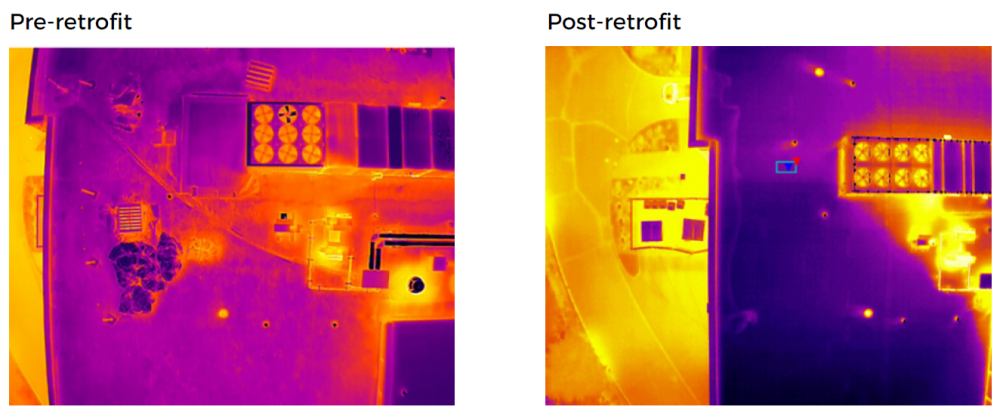
Thermal images of the commercial office building roof before and after the retrofit was completed. The darker hues in the post-retrofit image display the reduced energy loss on the roof.
Using AI to Forge a Path Towards a Greener Built Environment
AI is revolutionizing the way we optimize building envelope performance, turning a once costly and invasive process into a scalable science. This technology shifts the paradigm from manual, time-consuming inspections to rapid, data-driven insights. As a result, it streamlines the transition from problem identification to retrofit implementation, rendering deep energy savings far more achievable. As the industry adopts these advanced tools, we move closer to a built environment that is cleaner, smarter, and more sustainable.