

- Adaptive Reuse
- AI
- Insights
- Retrofit Plans
From Vacant Offices to Viable Housing: Why Building Intelligence Matters in Adaptive Reuse
October 20, 2026
Office-to-residential conversion has become one of the most talked-about strategies for addressing two challenges at once: persistent office vacancy and housing shortages. The logic is compelling—repurpose underutilized buildings rather than demolishing them and starting over. But there is a fundamental problem with treating conversion as a universal solution: not every office building can become housing.
An empty office building may appear to be an obvious candidate for adaptive reuse but industry research found that across more than 1,300 potential office-to-residential conversions across North America only 25% of the buildings assessed were suitable candidates for conversion.
Before owners spend significant capital on design, approvals and financial modelling, they need to understand whether the existing building can physically support its intended future.
Vacancy Does Not Equal Conversion Potential
In practice when it comes to office to residential conversions, residential building requirements can expose limitations that were less important when the building was designed for commercial use. Floor plate depth, access to daylight, and window configuration can all influence whether effective residential layouts are possible.
The building envelope, the physical separator between the conditioned and unconditioned environment of a building, adds another critical layer to this assessment with existing building facades considered essential when determining the financial feasibility of conversion projects. A façade that was adequate for office occupancy may require substantial rehabilitation or replacement to support a high-performing residential building. Insulation, windows, air leakage, moisture intrusion and thermal bridging all affect resident comfort, energy performance, code compliance and ultimately the cost of bringing the building into its next use.
Building Envelope Intelligence Should Come Before Conversion Investment
Traditional feasibility studies often rely heavily on architectural drawings, visual inspections, and historical documentation. While important, those inputs may not reveal the full story of what is happening across thousands of square feet of façade.
Precise building envelope intelligence can provide a much more granular picture of the physical conditions, energy performance, and residential comfort of an asset before major decisions are made.
For example, QEA combines industrial drones, high-resolution visual and thermal imaging, IoT sensors and patented AI-powered analysis to identify and quantify building envelope deficiencies. Leveraging this data, QEA is able to create targeted retrofit action plans that include details on implementation costs, potential energy savings, and ROI.
For an office building being considered for residential conversion, that level of intelligence can help answer several important questions:
1. What condition is the existing building envelope actually in?
2. Where are the most significant thermal and moisture risks that would impact residents?
3. Which façade components are likely to require intervention?
4. Where could building envelope upgrades materially improve energy performance and occupant comfort?
5. What retrofit measures should be prioritized?
6. What will building envelope investment look like alongside the broader conversion strategy?
Rather than treating the building envelope as an unknown cost in a future renovation budget, owners can gain a detailed understanding of the technical and financial feasibility of converting this critical building component for residential use.
Scalability is Necessary for Determining Adaptive Reuse Strategies
For owners, developers and investors evaluating underperforming office assets with potential for conversion to residential, the challenge is often determining which buildings require further investigation. A scalable approach is needed to efficiently and cost-effectively determine which buildings are suitable candidates for conversion before investing significant resources.
By leveraging technology such as QEA’s, stakeholders quickly gain a comprehensive understanding of building envelope performance across entire portfolios. Stakeholders can identify buildings with significant building envelope investment requirements that may benefit from a different remediation strategy than conversion to residential. That distinction can save owners from spending time and capital pursuing buildings that are not physically viable for a conversion.
Case Study: AI Building Envelope Intelligence to Strengthen Office-to-Residential Conversion Strategy
A portfolio owner leading several office-to-residential conversions leveraged QEA’s building envelope intelligence platform to assess the risks involved in converting one of its office buildings for residential use. Conversion decisions have lots of unknowns and the property owner needed to understand whether the existing building envelope components could support the building’s next use—and, if not, how much intervention would be required.
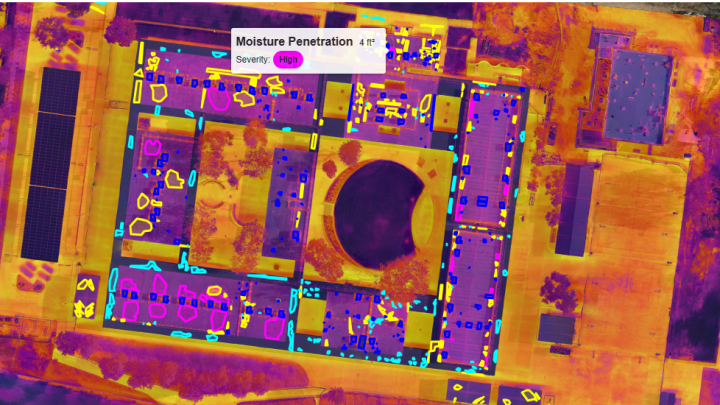
QEA’s analysis provided a detailed picture of building envelope performance, pinpointing and quantifying a wide variety of deficiencies down to inches. For an office-to-residential conversion, understanding factors such as insulation continuity, air leakage, thermal bridging, and moisture penetration is critical to determining what building envelope components can be retained and what may require remediation to support residential use. In this case, key envelope risks included moisture penetration on the roof and air leakage around windows.
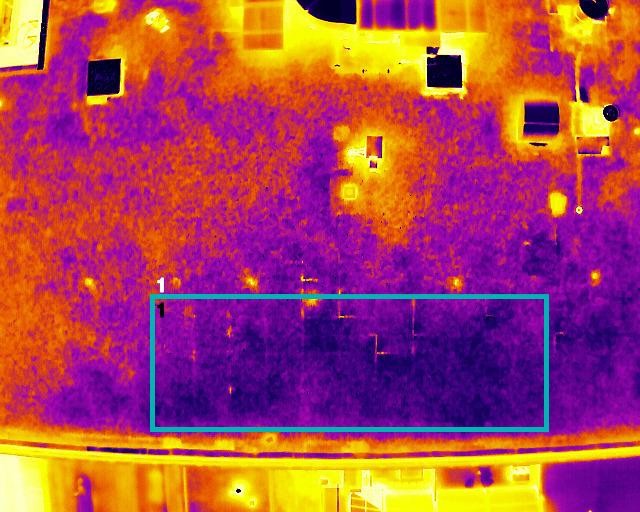
Moisture Penetration on the Roof
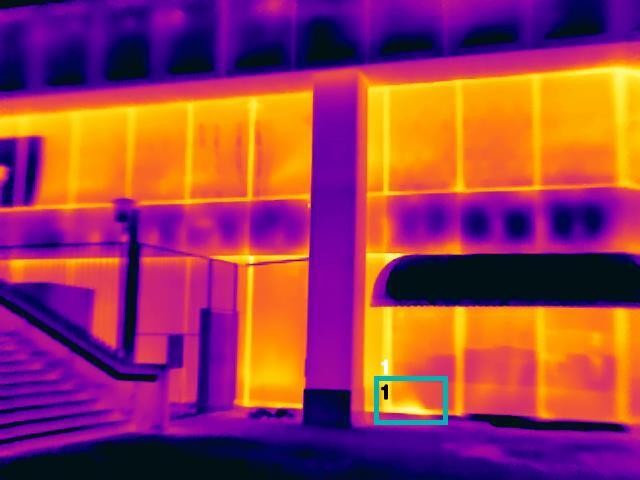
Window Air Leakage
These issues were important to consider as existing moisture problems can become significantly more consequential for a residential space. Moisture penetration can contribute to deterioration of insulation, reduce thermal performance and increase the risk of mold and poor indoor air-quality. These risks are particularly important to address in residential buildings, where consistent thermal comfort and indoor environmental quality are critical. Identifying the source, extent, and severity of moisture intrusion before conversion allows owners to determine whether targeted repairs or more extensive rehabilitation will be required, preventing concealed deficiencies from becoming costly post-conversion issues.
As for window air leakage, uncontrolled air movement through windows creates drafts and localized comfort issues for residents while also increasing heating and cooling demand. By pinpointing specific instances of air leakage, QEA provided the owner with a clear indication of where targeted window upgrades may need to be considered as part of the conversion strategy.
Rather than simply identifying building envelope issues, QEA also measured the effective R-value (thermal resistance) of each building envelope component, determining how components performed in comparison to building code. This was an important insight as the existing office building was likely designed to a different energy code and performance standard than what is required for residential buildings.
Additionally, a measurable 3D model of the building was created, allowing stakeholders to precisely locate deficiencies across the building envelope and visualize where targeted upgrades may be required.
Leveraging these detailed insights on building envelope performance, QEA created a tailored retrofit action plan. To address moisture penetration and energy deficiencies on the roof, QEA recommended removing localized instances of wet insulation and adding spray foam insulation. Spray foam insulation was a financially feasible option, providing a payback period of 4 years. It also provides a continuous thermal and vapor barrier, ensuring there is no path for moisture to enter. To address window air leakage, QEA recommended adding window inserts – customized glass panes that can be placed on the inside or outside of the existing window. These inserts seal drafts and create a new thermal boundary that improves R-values. Window inserts delivered a payback period approximately 4 times better than traditional window replacement.
The Future of Adaptive Reuse Is Data-Driven
Office-to-residential conversion remains an important opportunity in the fight against stranded assets and housing shortages, but it should not be approached as a one-size-fits-all solution.
The strongest candidates will be the buildings where market demand, financial feasibility, and building conditions align.
Understanding the building envelope is an important part of that equation.
Accurate intelligence allows owners to replace assumptions about existing building envelope performance with precise issue and component specific data—helping them understand where deficiencies exist in order to develop more informed capital plans. With this data in mind, building stakeholders can target resources to the most suitable candidates for residential conversion all while ensuring capital for each conversion is optimized.
Subscribe to Get Our Latest Updates





- Featured
- Insights
- Prop Tech
- Retrofit Plans

- AI
- Insights
- Retrofit Plans

- AI
- Certification
- Energy Efficiency
- Insights
- Retrofit Plans
- AI
- Energy Efficiency
- Featured
- Insights
- Retrofit Plans
- AI
- Featured
- Measurable 3D Models
- Retrofit Plans
- Roofs
- AI
- Insights
- Retrofit Plans
- Roofs

- AI
- Energy Efficiency
- Featured
- Retrofit Plans

- AI
- Energy Efficiency
- Insights
- Retrofit Plans

- AI
- Measurable 3D Models
- Retrofit Plans
- AI
- Energy Efficiency
- Insights
- Retrofit Plans

Get the Full Story
Enter your details to access the complete case study and see how data-driven retrofits deliver measurable results.