How AI Is Driving a New Era of Efficient Building Envelope Retrofits

Buildings are a leading source of energy consumption across the globe, accounting for a third of global energy consumption and a quarter of CO2 emissions. Improving the building envelope – the outer layer of a structure that includes walls, windows, roofs, and doors – is particularly important to achieving energy and emissions savings for buildings. Capable of achieving upwards of 30% of energy savings, high-performing building envelopes are the most effective way to reduce the thermal needs of buildings according to the International Energy Agency.

Barriers to Building Envelope Energy Efficiency – Lack of Actionable Data and Scale

Retrofits to the building envelope are a critical means to achieving major energy savings without having to demolish and rebuild the existing structure. Despite their importance, building envelope retrofits are frequently delayed, largely due to a lack of data on the issues and risks affecting the building envelope and the return on investment of retrofits. Traditional methods of analyzing the energy consumption of building envelopes rely on manual, imprecise, intrusive, and non-scalable methods that fail to yield a prescriptive business case for retrofits.

Scalability, Efficiency, and Detail: Transforming Building Envelope Analysis with AI

AI, paired with other technologies such as drones, can be used to simplify, optimize, and accelerate the retrofit planning process for the building envelope. Drones equipped with thermal and visual cameras are capable of collecting thousands of high-resolution, close-proximity images across the entire building envelope in a short amount of time. This enables the creation of comprehensive datasets built off of millions of data points that encompass various building envelope materials (e.g., brick, concrete, glass, wood), structures (e.g., high-rises, low-rise residential, industrial warehouses), and façade shapes (e.g., rectangular, curved, irregular). Datasets can be further enriched through data processing and augmentations that simulate additional variations.

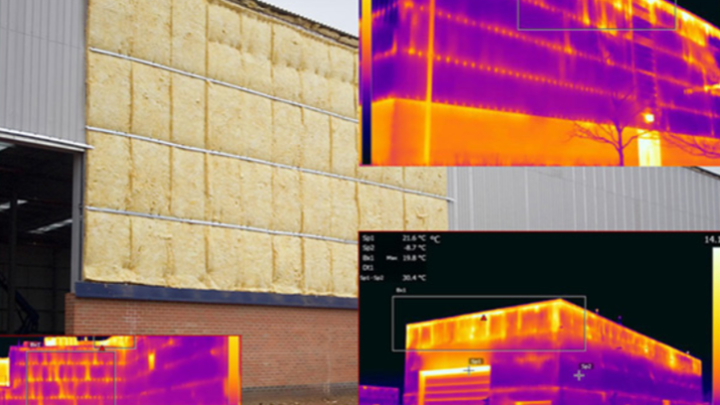
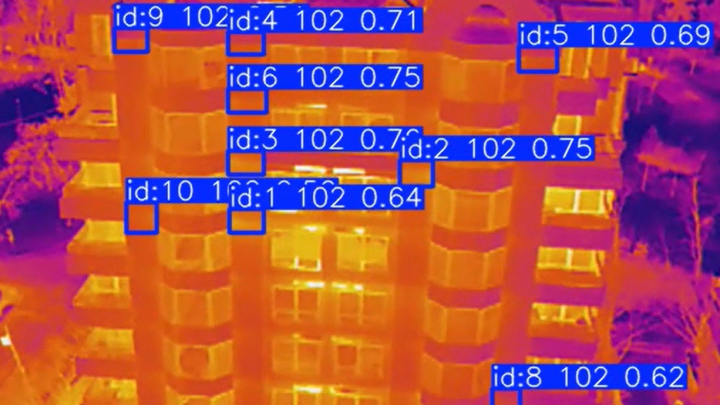
This data can then be fed into AI models that are trained to identify varying instances of energy loss and physical deficiencies across the building envelope (e.g., air leakage, moisture penetration, decaying insulation). Detecting each of these issues may involve using different thermal tunings and color palettes to more easily highlight specific anomalies.

Once building envelope issues are identified, AI can be used to create action-oriented retrofit plans through large language-based recommendation modules. Rules-based algorithms, built off of detailed datasets on possible building envelope retrofits, can be used to recommend fitting retrofits based on specific building envelope issues identified. Machine learning models, factoring in quantitative details on the building envelope such as square footage, can then take the list of recommended retrofits and estimate project costs, forecasted energy and cost savings, and return on investment. These outputs can then be fed into a large language model to deliver actionable retrofit plans.

Overall, leveraging AI models can notably speed up and improve the building envelope analysis and retrofit planning process, allowing for the precise analysis of extremely large datasets within a fraction of the time it would take for a human to analyze data.

Real Life Use Cases: Optimizing Retrofit Planning with AI Tools

A large warehouse located in the UK, spanning over 1 million square feet, needed an efficient and scalable way to pinpoint key areas of energy loss across the facility’s expansive building envelope. Leveraging sophisticated AI models, the warehouse was able to quickly process and analyze over 10,000 high-resolution visual and thermal images of the building envelope, pinpointing over 1,300 issues related to building envelope energy loss and physical deficiencies. The analysis pinpointed air leakage from skylights and garage doors as being key sources of energy loss, and a business case for specific and tailored retrofits with clear payback and ROI was established.

Similarly, a large commercial office building based in Canada, spanning over 60,000 square feet, leveraged AI tools to prioritize which retrofits to complete for its building envelope. By using AI, the building was able to efficiently and accurately identify 131 building envelope issues that required action. An ineffective thermal layer on the roof was identified as a significant source of energy loss that could be cost-effectively resolved by adding insulation. In a post-retrofit AI analysis, it was determined the building saved 78% of annual energy loss from the roof and over $20,000 in annual energy costs.
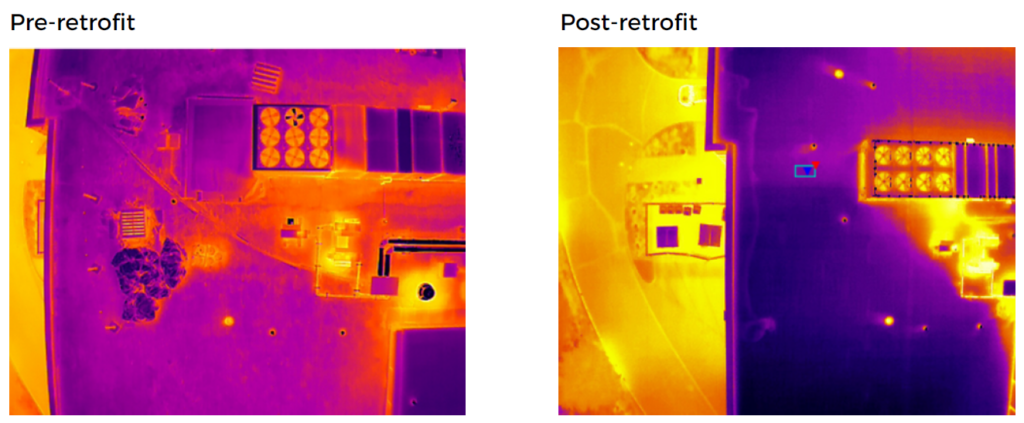
Thermal images of the commercial office building roof before and after the retrofit was completed. The darker hues in the post-retrofit image display the reduced energy loss on the roof.

Using AI to Forge a Path Towards a Greener Built Environment

AI is revolutionizing the way we optimize building envelope performance, turning a once costly and invasive process into a scalable science. This technology shifts the paradigm from manual, time-consuming inspections to rapid, data-driven insights. As a result, it streamlines the transition from problem identification to retrofit implementation, rendering deep energy savings far more achievable. As the industry adopts these advanced tools, we move closer to a built environment that is cleaner, smarter, and more sustainable.

QEA’s Roof Assure Audit – Protect Your Roof, Protect Your Bottom Line

QEA is excited to announce the latest addition to our market leading, AI-powered building envelope assessment services – QEA’s Roof Assure Audit. Leveraging sophisticated AI models, thermography, and industrial drones, QEA’s Roof Assure Audit provides the precise insights needed for building owners to address issues before they grow into costly problems.

QEA’s Roof Assure Audit incorporates several proprietary innovations to tackle the essential aspects of managing your roof.  The Roof Assure Audit:

1. Pinpoints physical issues, risks, and deficiencies throughout the roof (e.g. moisture penetration, wet insulation, corrosion, blisters, debris) down to inches or centimeters.

2. Accurately measures megawatt-hours (MWh) of energy loss, tons of carbon emissions, forecasted energy and emissions savings, and the effective R-value for each square inch or centimeter of the roof.

3. Provides customized retrofit plans that detail a cost-benefit analysis for various roofing solutions, with each plan tailored to maximize ROI.

QEA’s Roof Assure Audit is backed by robust AI models trained on hundreds of thousands of high-resolution (8k+), high proximity, annotated thermal and visual images of roofs. This ensures the highest levels of accuracy, precision, and speed in analysis. Our extensive database is built on over 1,100 projects completed for a diverse portfolio of commercial, residential, institutional, and industrial buildings, ensuring optimal accuracy in analysis.

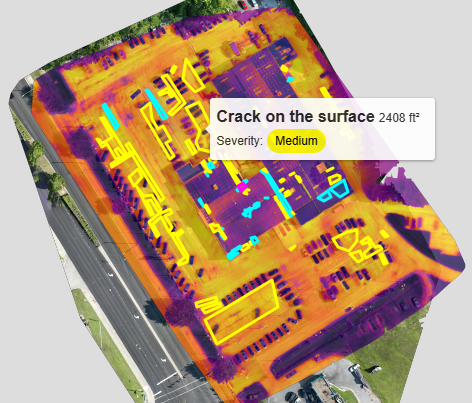
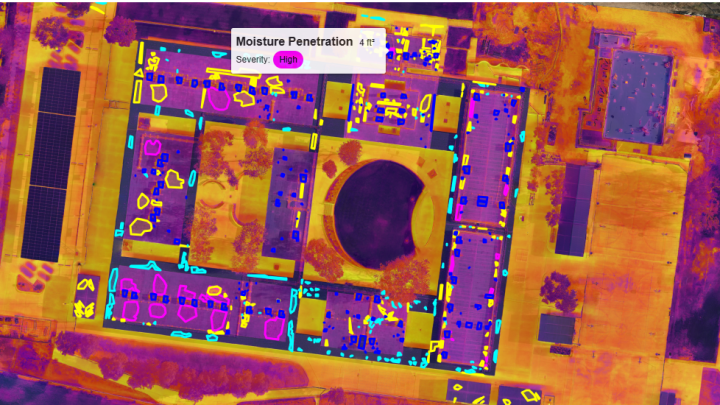
The Roof Assure Audit begins with comprehensive data collection using industrial drones and QEA’s proprietary sensors. Once data is collected, QEA’s AI models and team of building science specialists diagnose various roofing issues and risks and present solutions that optimize ROI. The Roof Assure Audit delves deeper than traditional audits by detailing severity, square footage, and material impacted by each issue. All of this information is presented on a high-quality, digital twin of the roof, creating an intuitive visual model of roof performance.

Example of a digital twin of the roof which includes a thermal overlay and markers identifying key roofing issues. For each issue size and severity are detailed.

QEA’s Roof Assure Audit delivers custom retrofit solutions tailored to the needs of each roof. Each solution includes details on implementation costs, forecasted energy savings (MWh), and payback periods. Building owners can quickly understand optimal retrofit decisions, such as whether targeted repairs or a full roof replacement delivers a better ROI. Through QEA’s expansive network of roofing solutions partners, we ensure accurate costing information and can facilitate retrofit implementations, streamlining the entire retrofit process.

QEA’s Roof Assure Audit delivers an unmatched level of precision, accuracy, and detail, empowering building owners to establish strong business cases needed to justify roofing retrofits. With hundreds of successful deployments across multiple countries, QEA’s Roof Assure Audit is helping building owners understand the lifespan of their roof, mitigate roofing risks, prioritize repairs and retrofits based on necessity and ROI, and ensure compliance with roofing regulations.

Contact Us today to maximize the lifespan of your roof with data-backed and ROI-driven insights.

QEA Tech Receives Support to Advance AI-Driven Building Envelope Retrofit Technology

QEA Tech, a leading provider of AI-driven building envelope audits, is thrilled to announce that it is receiving advisory services and up to $4,200,000 CAD in funding from the National Research Council of Canada Industrial Research Assistance Program (NRC IRAP) to support research and development for its patented building envelope audit technology.

This support will enable QEA Tech to conduct building envelope audits for 350 buildings, including commercial, residential, industrial and institutional facilities, with the support of industry partners. These audits will quantify energy loss throughout the building envelope, pinpoint important building envelope issues and risks, and identify high-impact retrofit opportunities that maximize energy savings and ROI. Data collected through these audits will be leveraged to enhance QEA Tech’s AI-driven retrofit recommendation software, leading to a fully automated solution that delivers detailed, targeted, and cost-effective retrofit plans. As a result, the building retrofit process is expected to be faster, more affordable, and more accessible for building owners.

Improving building performance is crucial for meeting pressing climate goals as buildings are responsible for a third of global energy consumption. The building envelope plays a critical role in the overall energy efficiency of buildings accounting for upwards of 30% of the total energy lost in a given building. Technology like QEA Tech’s can facilitate a smoother transition to achieving energy efficiency and operational savings for building envelopes.

“QEA Tech thanks NRC IRAP for supporting our mission to make retrofits more accessible, scalable and cost-effective for building owners. A data-driven approach such as QEA Tech’s is important in providing a thorough understanding of how to fix faults within the building envelope and improve energy efficiency. This funding will allow us to expand our impact and advance the technology that makes this possible.” – Peyvand Melati, CEO

QEA Tech looks forward to using the support from NRC IRAP to continue its path of innovation, pioneering solutions to make building envelope retrofits seamless, cost-effective, and scalable.

About QEA Tech

QEA Tech conducts precise, data-driven building envelope audits using patented AI software, drones, and thermography. A pioneer and market leader in AI-driven envelope analytics, QEA Tech delivers audits that are fast, cost-effective, and non-intrusive. QEA Tech’s audits quantify energy loss and forecasted savings for each square inch of the building envelope, pinpoint envelope issues down to inches, and deliver targeted retrofit plans that maximize energy savings and ROI. To date, QEA Tech has audited nearly 1,000 building envelopes across North America, Europe, and Asia, for a diverse portfolio of commercial, residential, industrial, and institutional facilities. As a result, QEA Tech has developed one of the largest structured databases on the thermal performance of building envelopes.

What to Ask Building Envelope Analysis Vendors for Optimal Insights

QEA Tech has long been a pioneer in leveraging AI, drones, and thermography to conduct building envelope analysis, precisely identifying issues, quantifying energy loss, and delivering highly targeted retrofit recommendations with optimal payback periods and return on investment (ROI). While QEA Tech was officially incorporated in 2019, our core technology underwent extensive development for several years prior.

In QEA Tech’s formative years, when first engaging with prospective clients, the concept of using AI and drones to conduct building envelope analysis was largely overlooked. At best, the methods employed were manual, arduous, and rudimentary. Common practices included using a handheld camera to capture a limited number of thermal or visual images from the ground, followed by a laborious manual review to interpret anomalies. Other scenarios involved individuals physically walking roofs or using scaffolds to visually inspect building facades. Even when helicopters equipped with thermal cameras were deployed to capture larger quantities of data, the resulting images required manual, subjective interpretation. These conventional methods proved intrusive, expensive, often open to misinterpretation, non-scalable, and fundamentally failed to yield actionable data or insightful conclusions on the building envelope.

Today, numerous emerging startups are leveraging AI, drones, and thermography for building envelope analysis. However, it is important to ensure that these technologies are being used in a way that ensures detailed analysis and accuracy. To ensure the AI and drone service you select provides reliable conclusions and recommendations, consider asking the following critical questions:

How many buildings have you directly analyzed?

A significant challenge in developing and refining AI models and algorithms for accurate issue diagnosis and energy loss quantification is the acquisition of a sufficient volume of high-quality data. The comprehensive accumulation of such data necessitates the completion of hundreds of direct, hands-on projects. While some firms may claim an abundance of data points, these are often derived from publicly available sources or peripheral drone scans, which do not offer the granular detail required for an in-depth building envelope analysis.

QEA Tech has successfully completed nearly 800 building envelope projects as of 2025. In each of these engagements, we meticulously captured thousands of data points and measured R-values for every square inch of the structures. Furthermore, we integrated diverse building documentation, including architectural drawings and utility bills, to continuously refine our analysis and retrofit recommendations.

What kind of building envelope data do you capture?

A high volume of visual and thermal images at a close distance using high-resolution cameras is essential to mitigate reflections and distortions. In contrast, some firms may use drones to superficially capture a few dozen images of multiple buildings or large areas of the building envelope. Images obtained through these less rigorous methods offer a crude resolution, precluding any granular or accurate analysis, thereby rendering conclusions and recommendations unreliable.

QEA Tech captures thousands of high-resolution RGB and thermal images for each building. We employ a number of proprietary techniques and trade secrets in the capture and processing of these images. We also leverage proprietary sensors that collect various data points that are vital for calibrating our energy loss measurements.

What exactly does your AI do?

“AI” has become a ubiquitous and often overused term. It is important to understand that not all AI is developed or functions identically. To be effective, AI needs a large volume of high-quality data to continually tune and refine its capabilities.

QEA Tech has meticulously developed, trained, and fine-tuned our AI models specifically to quantify energy loss and identify distinct signatures and patterns associated with issues such as moisture penetration, thermal bridging, and missing or inconsistent insulation. QEA Tech holds several patents for these advanced capabilities.

How specific are your retrofit recommendations?

Some firms may provide generic, “cookie-cutter” recommendations that are high-level, often accompanied by inaccurate or entirely absent costing information.

QEA Tech delivers specific and actionable retrofit measures for the building envelope, complete with payback periods and ROI, directly tailored to the issues and risks identified through our analysis. QEA Tech offers a comprehensive menu of repair and retrofit options that are utilized to develop robust business cases for our clients. QEA Tech’s detailed approach empowers clients to forecast and plan their budgets for several years into the future, enabling them to prioritize which repairs and retrofits should be executed on which buildings, and in what sequence. Our methodology provides a quantitative, evidence-based decision-making framework to justify both operational and capital expenditures with concrete data.

What is the actual energy loss you are quantifying?

While many firms claim to “quantify energy loss,” this assertion can often be vague. Firms often rely heavily on generic assumptions based on the building type, materials or age. It is critical to also analyze data such as energy utilization and costs to begin to accurately quantify energy loss.

QEA Tech precisely quantifies the effective U-value or R-value and megawatt-hours (MWh) of energy loss for every square inch of the building envelope and for each individual building envelope element. We meticulously measure the actual energy transmittance throughout the building envelope, incorporating on-site data pertaining to various temperature and atmospheric conditions, building documentation and drawings, energy utilization and rates, and building usage data to ensure an exceptionally accurate measurement of energy loss. This level of granularity is what allows us to recommend highly targeted retrofits with detailed payback and ROI calculations, which are instrumental in developing business cases for internal budget planning and approvals by our clients.

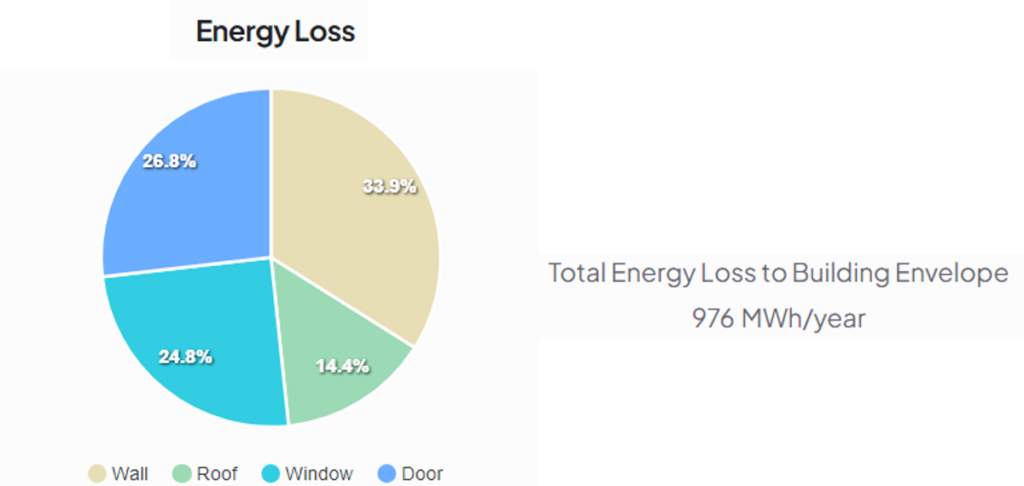
Example of building envelope energy loss measurements conducted by QEA Tech’s software. 

What kind of patents are in place, and are they directly relevant to building envelope analysis?

Firms should be able to clearly articulate what renders their software proprietary and unique. Some may utilize open-source software components that do not offer the requisite degree of detailed analysis and accuracy.

QEA Tech holds several patents, including those for the quantification of energy loss using thermal imaging and pattern recognition of thermal anomalies. Additionally, QEA Tech possesses a number of trade secrets related to the capture, processing, and analysis of building data.

Do you have a Building Science team?

The presence of dedicated experts who conduct quality control on AI-driven analysis and apply their specialized knowledge to tailor results and recommendations to building needs is paramount. Every building is unique in its construction, characteristics, usage, maintenance history, and resilience to environmental elements. Therefore, firms must avoid a “cookie-cutter” approach to analysis and exercise diligence in formulating specific and customized recommendations for repairs and retrofits.

QEA Tech has a dedicated Building Science team comprising experts in architecture, mechanical engineering, facilities management, and building science. Our team collaborates seamlessly with our proprietary software to ensure highly detailed and customized analysis and recommendations for each building. Over several years, our Building Science team have played a critical role in refining our AI software’s capabilities. Our Building Science team is engaged throughout the entirety of each project, from preliminary building reviews and advising on drone and data collection protocols, to pinpointing specific areas on the building envelope requiring additional attention and data, to quality control of software-generated analysis, and developing tailored recommendations for repairs and retrofits with detailed payback and ROI calculations.

Understanding the details of what a vendor can provide is essential to ensuring you are getting optimal value in the analysis of your building envelope. Interested in receiving thorough, tailored insights on the performance of envelopes in your portfolio? Contact QEA Tech for a free preliminary quote.

Pioneering AI-Powered Building Envelope Audits: Reflections from a Serial Energy Entrepreneur

In 2019, Peyvand Melati founded QEA Tech (QEA). As a serial entrepreneur of climate focused companies, QEA, Melati’s third-energy focused software venture, focuses on improving existing buildings which are responsible for 40% of global energy consumption. His goal was to transform building envelope efficiency through cutting edge technologies including artificial intelligence (AI), drones, and thermography.  

The building envelope – the physical separator between the conditioned internal environment and the external environment – was generally viewed as immutable without considerable investment and reconstruction. Prior to QEA, the standard inspection method involved walkthroughs with handheld thermal cameras, which provided limited visibility and effectiveness in diagnosing building envelope issues. However, with drone and AI technology, Melati believed that these non-invasive technologies could capture precise and actionable data on the building envelope, opening the door to targeted building envelope retrofits which improve building efficiency and contribute toward sustainability goals without necessitating major reconstruction.  

The Early Days of Auditing: Shutting Down Streets and Police Detail

As the pioneer of drone and AI-based envelope auditing, QEA initially faced skepticism within the industry. Stakeholders questioned both the practicality and safety of drone inspections, viewing them as risky, unproven, and disruptive to public spaces. 

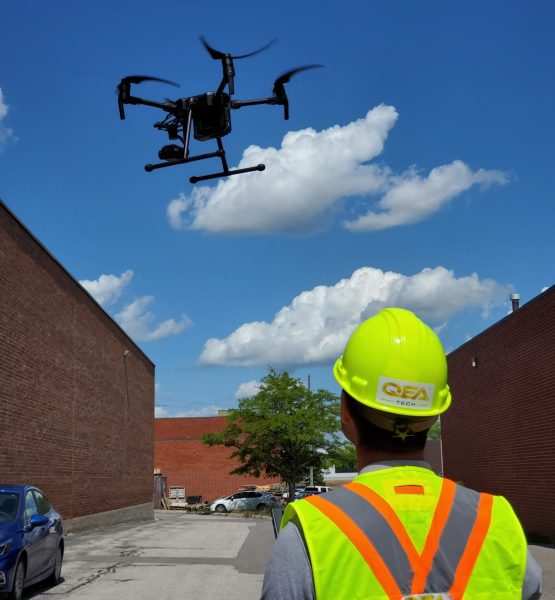
Early Days Operations (2019)
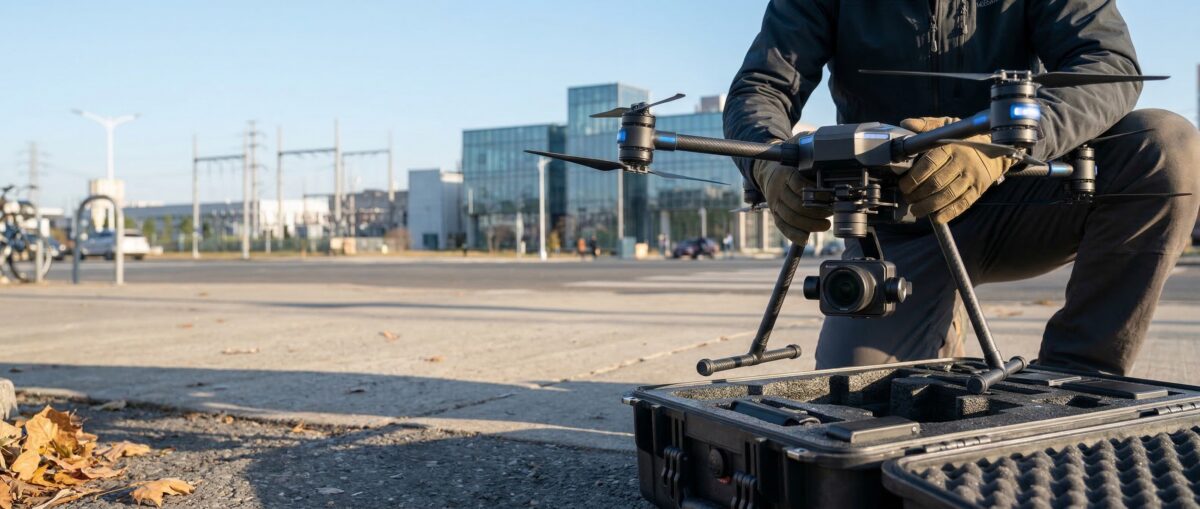
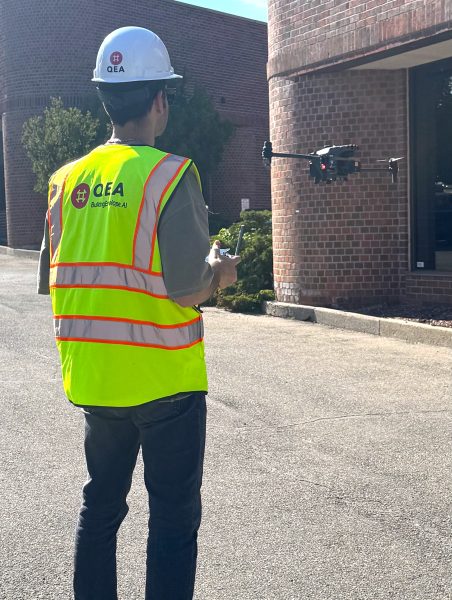
Present Day Operations (2025)

Melati recalled one of the earliest and most public demonstrations of QEA’s innovation involved shutting down one of the busiest streets in Toronto, complete with police detail and complex coordination with local authorities. The drone, which was 4 ft by 4 ft, caught the attention of passerby and sparked both curiosity and concern. Although the operation garnered much attention, it proved the utility and potential of drone technology to be an effective approach to building envelope auditing.  

QEA now uses much smaller drones, projects require less logistical coordination, and flights rarely attract the attention of people in the area. Drone technology has become the industry standard for comprehensive, scalable building envelope assessments.  

Detecting the Undetectable: Proving Value and Market Acceptance 

A key early moment that validated QEA’s innovative approach to major real estate owners and the industry at large involved the discovery of hazardous ice accumulation hidden in the façade of a large commercial building. Unlike previous inspection methods, QEA’s drone-based inspection captured thousands of thermal and visual images, and its patented software provided a granular level of detail in the analysis of the captured images. The façade issue would have been undetected by previous inspection methods, proving the quality and value of QEA’s precise methodology.  

Similarly, for another building, a QEA audit identified an abnormal heat spot on the roof. The audit sparked an investigation into the heat source, which found a disconnected duct that was previously unknown to the building management and explained the building’s excessive energy bills due to the stress on the heating and cooling system. QEA’s audit identified a fix to this issue that was straightforward, inexpensive, and led to substantial long-term energy savings.  

Better Drones and Better Analytics: Six Years and 700 Buildings Later

In its early history, QEA committed substantial resources to developing sophisticated, quantified analytical capabilities. Infrared imagery AI analysis requires an expansive dataset to develop the unparalleled level of precise detail that QEA provides today. It took nearly two years of intensive dataset development and approximately 150 buildings by 2022 to generate QEA’s highly accurate analysis capabilities. QEA’s extensive and proprietary dataset collected from hundreds of buildings leads the industry in offering unmatched and reliable insights into thermal abnormalities and building envelope performance.  

Further, QEA’s drones today are smaller, more agile, and equipped with advanced sensory arrays which enhance their stability, reduce risk, and improve the quality of data captured during inspection. Coupled with  proprietary IoT sensors, QEA scans identify a wide array of envelope issues at sub-inch levels.  

As QEA tops its 700th project, QEA’s AI-powered analytics are backed by its leading dataset on the building envelope and continually improve the unrivaled precision of quantified diagnostics at the industry’s leading level of accuracy. Further, QEA has patented its energy quantification methodologies and specialized AI models for detecting envelope anomalies, reinforcing the company’s leadership and technical expertise.  

Topping 1000 Buildings: From Diagnostics to Targeted Action Plans

QEA’s industry expertise and precision data led to the second phase of its product: comprehensive retrofit recommendations.  QEA audits now include detailed diagnostic assessments, actionable and specific retrofit recommendations, and projected energy savings reports, making the technology not only valuable for understanding the building envelope at a highly detailed level, but crucial for informed decision-making and strategic action in building management.  

Reflecting on QEA’s evolution, Melati highlights that while diagnostic excellence remains essential, the ultimate objective is to drive tangible results in the built environment—measurable energy conservation and decarbonization. QEA’s emphasis on actionable insights reflects its broader commitment to global sustainability objectives and environmental protection.  

Today, QEA has established itself as the global leader in data-driven building envelope assessments. Having completed projects for more than 60 clients in North America, the UK, Europe, and Asia, QEA will soon surpass a landmark 1000 buildings audited. Since 2019, many drone-based inspection services for various use-cases have emerged. However, QEA maintains the first-mover advantage. The company is distinguished by its speed, non-invasiveness, and comprehensive accuracy, delivering precise, quantified insights that directly support targeted energy efficiency improvements. With the largest thermal dataset on building envelopes in the world and a first-of-a-kind experience alongside proprietary industry knowledge, QEA ensures its edge over other building envelope solution providers.  

Interested in receiving detailed and actionable insights to improve building envelope performance? Contact QEA Tech for a free quote.